API
Description
This article describes the Skills Workflow API.
Every other integration in this section is, underneath, this API being used. It is the interface any external system uses to read and write Skills Workflow data directly — clients, suppliers, users, jobs, projects, estimates, expenses, files and more — without a person entering it by hand.
It exists for the cases the packaged integrations do not cover. When an agency runs a system nobody has built a connector for, or wants to automate something specific to how they work, the API is what makes that possible without waiting for a product change. It is also how an implementation partner loads data during onboarding, and how a client's own systems can be wired into the platform.
Two collections are published:
- Integration API — the endpoints for provisioning and maintaining master data, such as users and employees.
- Client API — the broader day-to-day object model: jobs, projects, contracts, requests, estimates, expenses, assignments, comments, files and workflow.
The API is versioned and additive: it keeps growing, but without breaking what already works — so an integration built against it does not need revisiting every release.
Authentication
API URLs:
- API: https://integration-api-we.skillsworkflow.com/
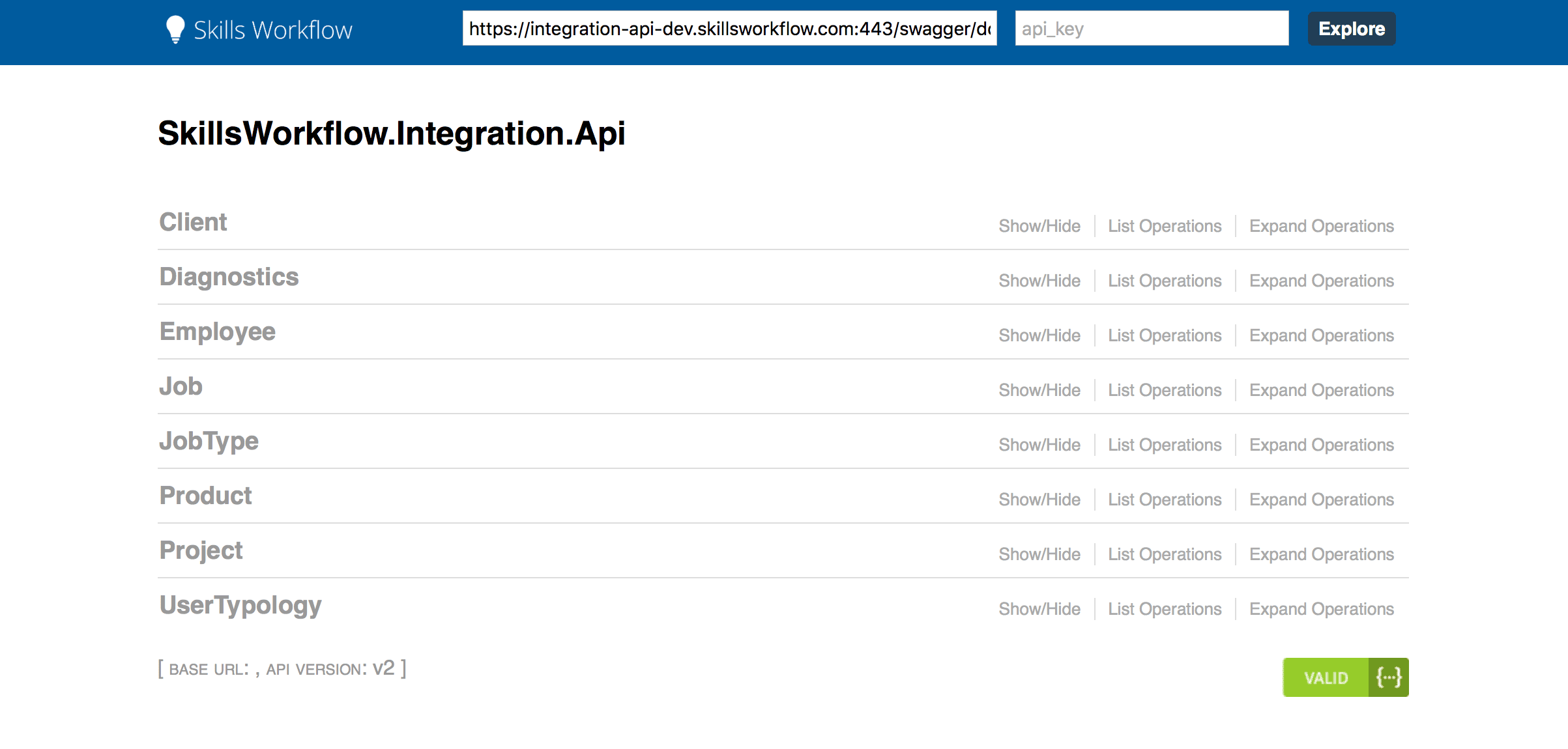
- Docs: https://integration-api-we.skillsworkflow.com/swagger/ui/index
You can try the API directly from the documentation, or you can use other application (e.g. PostMan)
To use the API you will need to send 3 Headers in the request, as required in the documentation: X-AppTenant, X-AppId and X-AppSecret
You can also check our open source site and check some examples of using the API: https://github.com/SkillsWorkflow/api-demos
If you need to, please request the test (UAT) environment credentials for your Agency:
- X-AppTenant
- X-AppId
- X-AppSecret
Example on how to get all companies:

The API is constantly evolving (but never having breaking changes):
- If you need something that you do not find in the API, do not hesitate to ask and we will analyze the feasibility of adding to the API
Billing Client
Adding new billing client
To add a new Billing Client, you must specify the following properties:
- ExternalId
- CompanyCode
- Name
The External Id should match the unique identifier of the Billing Client in the external system. If the client already exists, it will be updated using the External Id and Company Code as the key.
Method: POST
Endpoint: /api/billingclients
Payload:
{
    "name": "string",
    "companyId": "3fa85f64-5717-4562-b3fc-2c963f66afa6",
    "companyCode": "string",
    "externalId": "string",
    "code": "string",
    "number": "string",
    "street": "string",
    "street2": "string",
    "stateProvince": "string",
    "city": "string",
    "cityId": "3fa85f64-5717-4562-b3fc-2c963f66afa6",
    "zipPostal": "string",
    "country": "string",
    "countryId": "3fa85f64-5717-4562-b3fc-2c963f66afa6",
    "active": true,
    "taxpayerNumber": "string",
    "paymentConditionExternalId": "string",
    "setFirstPaymentConditionIfExternalIdIsNull": true,
    "applyDefaultPaymentCondition": true,
    "currencyExternalId": "string",
    "applyDefaultCurrency": true,
    "otherDebtor": true
}
Commercial Client
Adding new commercial client
A Commercial Client should be created after all Billing Clients for a given company have been created.
Billing Clients are grouped and created based on their Company Code. Once all Billing Clients and the Commercial Client have been created, the Commercial Client must be associated with each corresponding Billing Client (one-to-one mapping based on Company Code).
To create a Commercial Client, you must specify the following properties
- Name
- ExternalId.
The External Id used for the Commercial Client should match the unique identifier of the Billing Client in the external system (the same External Id used when creating the Billing Client).
Method: POST
Endpoint: /api/commercialclients
Payload:
{
    "id": "3fa85f64-5717-4562-b3fc-2c963f66afa6",
    "name": "string",
    "externalId": "string",
    "nameAndExternalId": "string",
    "code": "string",
    "number": "string",
    "street": "string",
    "street2": "string",
    "stateProvince": "string",
    "blocked": true,
    "taxpayerNumber": "string",
    "country": "string",
    "countryId": "3fa85f64-5717-4562-b3fc-2c963f66afa6",
    "zipPostal": "string",
    "city": "string",
    "cityId": "3fa85f64-5717-4562-b3fc-2c963f66afa6",
    "commercialPaymentConditionExternalId": "string",
    "clientGroupExternalId": "string",
    "projectOwnerExternalId": "string",
    "setFirstPaymentConditionIfExternalIdIsNull": true,
    "applyDefaultPaymentCondition": true,
    "companyId": "3fa85f64-5717-4562-b3fc-2c963f66afa6",
    "timesheetLevelId": "3fa85f64-5717-4562-b3fc-2c963f66afa6",
    "insertUpdateCheckOnlyId": true,
    "_options": {
    "ignoreCode": true,
    "linkDefaultCompany": true
    }
}
Associate with billing client
To associate a commercial client with a billing client, you must indicate the id of the commercial client creation response, the id and the companyId of the billing client creation response, so as to be unique per company.
Method: POST
Endpoint: /api/commercial-client-companies
Payload:
{
    "companyId": "3fa85f64-5717-4562-b3fc-2c963f66afa6",
    "commercialClientId": "3fa85f64-5717-4562-b3fc-2c963f66afa6",
    "billingClientId": "3fa85f64-5717-4562-b3fc-2c963f66afa6",
    "externalId": "string",
    "vatExternalId": "string"
}
Supplier
Adding new supplier
To create a supplier, you must specify the follwing properties:
- ExternalId
- CompanyCode
- Name
The externalId should match the unique identifier of the supplier in the external system. If the supplier already exists, it will be updated using the externalId and companyCode as the key.
Method: POST
Endpoint: /api/suppliers
Payload:
{
    "name": "string",
    "externalId": "string",
    "companyId": "3fa85f64-5717-4562-b3fc-2c963f66afa6",
    "companyCode": "string",
    "taxpayerNumber": "string",
    "active": true,
    "street": "string",
    "street2": "string",
    "countryId": "3fa85f64-5717-4562-b3fc-2c963f66afa6",
    "city": "string",
    "cityId": "3fa85f64-5717-4562-b3fc-2c963f66afa6",
    "zipPostal": "string",
    "stateProvince": "string",
    "otherCreditor": true,
    "paymentConditionExternalId": "string",
    "applyDefaultPaymentCondition": true,
    "currencyExternalId": "string",
    "applyDefaultCurrency": true,
    "vatExternalId": "string",
    "applyDefaultVat": true,
    "_options": {
    "disableVatUpdate": true
    }
}
Marketplace Export Reference
Two Postman collections are published in the Marketplace under API: Client API (v15) and Integration API (v2). Source: [API] [Integrations] Client API v15 (Postman) {Active}.json, [API] [Integrations] Integration API v2 (Postman) {Active}.json.
Integration API (v2)
As exported, this collection has three requests — narrower than the Billing/Commercial Client and Supplier endpoints documented above, which are not part of this particular export (not determinable whether they've moved elsewhere or simply weren't included when this collection was exported):
| Request | Method & Endpoint | Notes |
|---|---|---|
| User | PATCH /api/users/{id} | Partial update; only send fields you want changed |
| User | POST /api/users | Create-or-update — send Id or ExternalId to decide which; UserName, Name, ExternalId, CompanyCode, DepartmentExternalId, TypologyExternalId, IsActive are required |
| Employee | POST /api/employees | Create-or-update — send Id or ExternalId; Name, ExternalId, CompanyId required |
Host: https://integration-api-{Environment}.skillsworkflow.com.
Client API (v15)
A much larger collection covering the day-to-day object model (host https://apiv2-{Tenant}.skillsworkflow.com, one request per folder shown; some environment-specific examples use a fixed tenant such as chronicle):
| Area | Endpoints |
|---|---|
| Additional Information | PUT /api/v3/documentUserFieldValues |
| Assignments | POST /api/assignments/batch |
| Comment | POST /api/posts (comment), POST /api/posts (link file) |
| Commercial Client | POST /api/v3/commercial-clients |
| Description | POST /api/documentBriefs |
| Estimate | POST /api/v3/estimates, PUT /api/estimates/{id}/items, POST /api/estimates/details/thirdparty, POST /api/estimates/details/resources, POST /api/estimates/details/expenses, POST /api/billing-conditions |
| Expense / Expense Sheet | POST /api/expenses, POST /api/expenses/{ExpenseSheetId}/items |
| File | POST /api/v3/file-system/folders/{folderId}/links |
| Job | PATCH /api/jobs/{jobId}, POST /api/v3/jobs |
| Project | PATCH /api/projects/{id} (and additional-information variant), GET /api/contracts/{id}/projects/new, POST /api/posts |
| Contract | PATCH /api/contracts/{id} (and additional-information variant), POST /api/posts |
| Typology | POST /api/v3/user-typology-histories, PATCH /api/v3/user-typology-histories/{id} |
| Request | POST /api/v3/requests, GET /api/v3/requests/{id} |
| User | POST /api/v3/users (create/duplicate), PATCH /api/users/{id}, POST /api/v3/commercial-client-users |
| Workflow | GET /api/v3/document-types/{id}/workflows?expandTransitions=true |
Open Questions
- The Integration API export (v2) has far fewer endpoints than this page already documented (Billing Client, Supplier, Commercial Client association) — not determinable from the export whether those moved to a different collection, a different version, or are simply outdated; they're left in place above since nothing here contradicts them.